
Introduction
Noun clauses play a crucial role in legal writing and communication. These clauses function as subjects, objects, or complements in sentences, and they add depth and complexity to legal texts. Understanding how to construct and use noun clauses effectively is essential for professionals working in the field of law. In this chapter, we will explore the characteristics of noun clauses in legal English and provide numerous example sentences to illustrate their usage.

Defining Noun Clauses
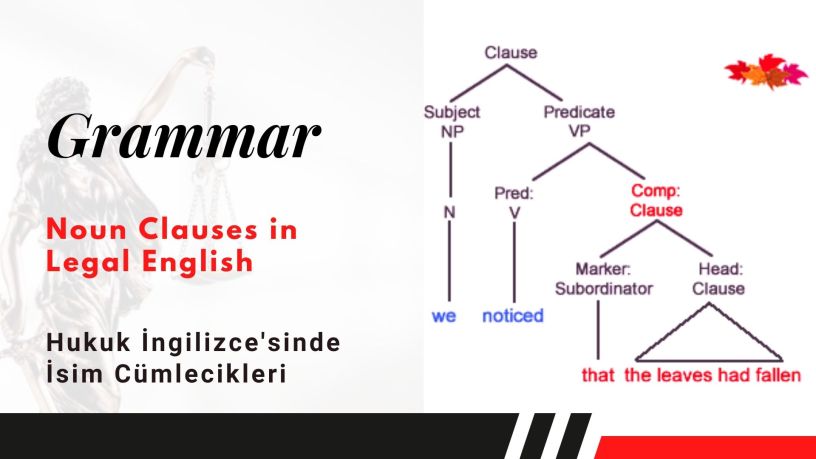
Noun clauses are dependent clauses that function as nouns within a sentence. They typically begin with introductory words such as
- “that,”
- “whether,”
- “if,” or
- “what.”
Noun clauses can serve various grammatical functions, including subject, object, and complement roles.
Example sentences:
- The court will decide whether the defendant’s actions constitute a breach of contract. (Mahkeme, davalının fiillerinin sözleşmeye aykırılık teşkil edip etmediğine karar verecektir.)
- The jury’s verdict will determine if the accused is guilty or not. (Sanığın suçlu olup olmadığını jürinin kararı belirleyecek.)
- It is essential to establish what the witness saw at the crime scene. (Tanığın olay mahallinde ne gördüğünü tespit etmek esastır.)
Noun Clauses as Subjects
Noun clauses can act as the subject of a sentence, replacing a noun or noun phrase. When a noun clause functions as a subject, it often introduces a question, doubt, or uncertainty.
Example sentences:
- Whether the defendant acted with intent remains to be proven. (Sanığın kasten hareket edip etmediği kanıtlanmayı bekliyor.)
- What constitutes a reasonable expectation of privacy is a key issue in this case. (Makul bir mahremiyet beklentisini neyin oluşturduğu bu durumda esas konudur.)
- Whether the statute is constitutional is a matter for the Supreme Court to decide. (Kanunun anayasaya uygun olup olmadığı yüksek mahkemenin karar vereceği bir konudur.)
Noun Clauses as Objects
Noun clauses can also function as objects of verbs or prepositions. They provide information about the action performed or the relationship between two entities.
Example sentences:
- The prosecutor argued that the defendant had no alibi. (Savcı, sanığın suç mahalinden başka bir yerde olmadığını savundu.)
- The judge instructed the jury on how to deliberate and reach a verdict. (Yargıç, jüriye nasıl müzakere edileceği ve bir karara varılacağı konusunda talimat verdi.)
- The contract stipulates when and how the payment will be made. (Sözleşme, ödemenin ne zaman ve nasıl yapılacağını belirtir.)
Noun Clauses as Complements
Noun clauses can serve as subject or object complements, providing additional information about the subject or object of a sentence.
Example sentences:
- His primary concern is whether the evidence is admissible. (Öncelikli kaygısı, kanıtın kabul edilebilir olup olmadığıdır.)
- The court declared the defendant innocent, which surprised many. (Mahkeme sanığı masum ilan ederek birçok kişiyi şaşırttı.)
- The key issue is what standard of care applies in this medical malpractice case. (Esas konu, bu tıbbi uygulama hatası vakasında hangi bakım standardının geçerli olduğudur.)
Reporting Verb Clauses
In legal writing, noun clauses are often introduced by reporting verbs, such as “claim,” “allege,” “argue,” or “believe.” These verbs indicate the expression of a legal opinion or assertion.
Example sentences:
- The plaintiff alleges that the defendant breached the contract. (Davacı, davalının sözleşmeyi ihlal ettiğini iddia etmektedir.)
- The defense attorney argued that the evidence was insufficient to prove guilt. (Sanık müdafii, delillerin suçu kanıtlamak için yetersiz olduğunu savundu.)
- The expert witness testified that the product design failed to meet industry standards. (Uzman tanık, ürün tasarımının endüstri standartlarını karşılamadığını ifade etti.)
Conclusion
Noun clauses are powerful tools in legal English, allowing lawyers, judges, and legal professionals to express complex ideas and construct well-structured arguments. By understanding how to use noun clauses effectively, legal practitioners can enhance the clarity and precision of their writing and communication. Mastering the nuances of noun clauses in legal English is an essential skill for success in the legal field.

FAYDALI OLMASI DİLEKLERİMİZLE
KATKI, GÖRÜŞ, ELEŞTİRİ VE SORULARINIZI BİZE YORUM OLARAK YAZABİLİRSİNİZ.

 Bu eser Creative Commons Atıf-GayriTicari-AynıLisanslaPaylaş 4.0 Uluslararası Lisansı ile lisanslanmıştır.
 HUKUK İNGİLİZCESİ
Thank you for this informative article! Noun clauses are indeed crucial in legal writing, and understanding their usage can greatly enhance communication in the field of law.